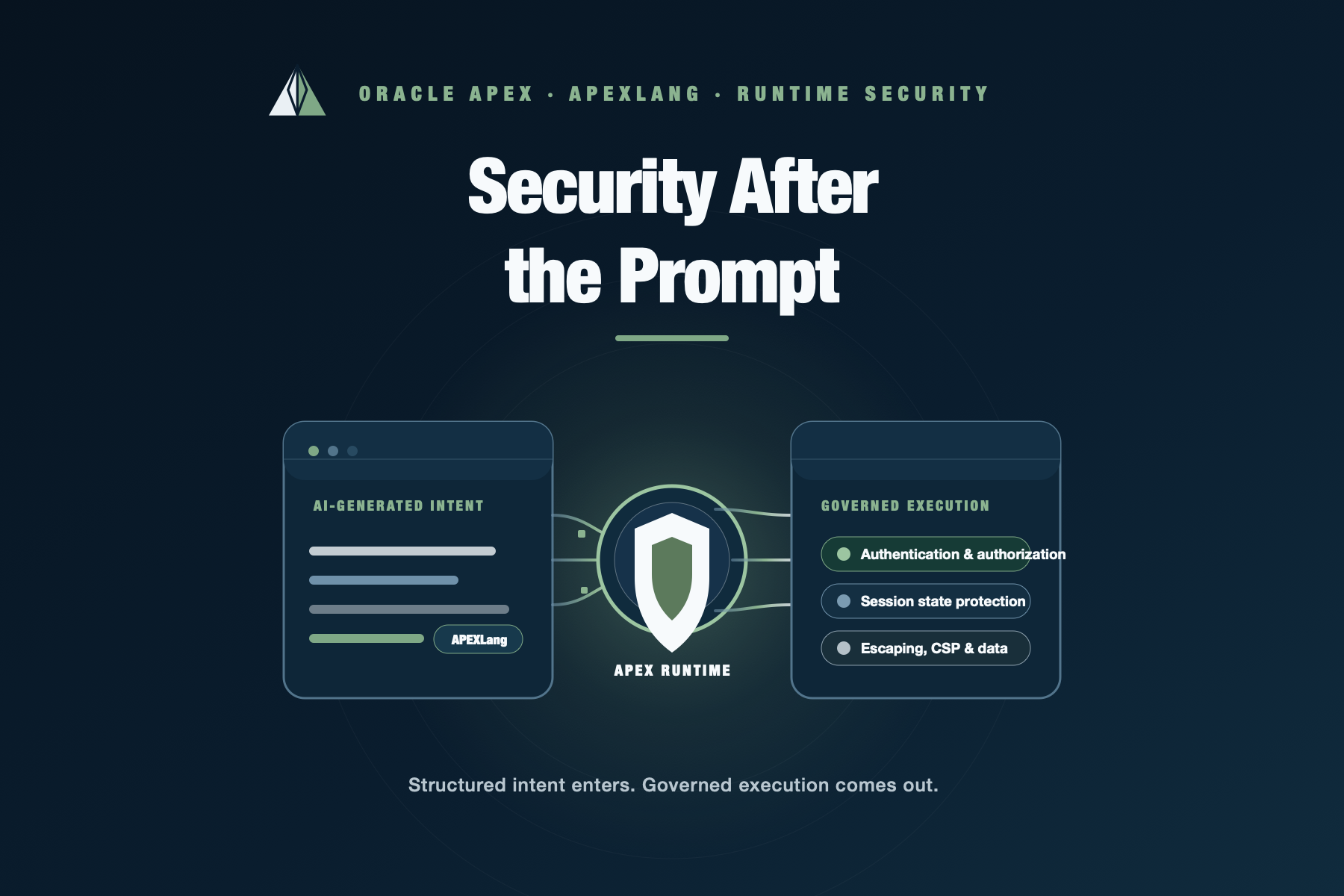
Security After the Prompt: Why the APEX Runtime Changes AI-Generated Applications
I have spent enough time reviewing enterprise applications to know that the first successful run is rarely the difficult part. The difficult part begins later, when someone has to explain why a user can see a page, where a secret is stored, which code changes data, how a session value arrived there, and what must be patched before the next release.
AI makes the first part much faster. A prompt can now produce pages, forms, reports, navigation, and business logic before a traditional project has finished arguing about its first sprint. That speed is useful, but it can also leave a team with a new version of an old maintenance problem: the application works, yet nobody is comfortable owning what was generated.
My curiosity about this subject started with two recent publications. The first was the HyperFRAME Research analysis, Oracle APEX: Transforming Enterprise Application Development with Declarative AI. A few days earlier, Michael Hichwa had published Oracle’s view in Oracle APEX AI Application Generator: Bringing AI to Enterprise App Development. Both articles make a strong argument: instead of asking AI to generate an entire web stack, APEX has it generate an application definition that the APEX runtime compiles and executes.
That argument assumes the reader already understands what the APEX runtime does. For someone who has never worked with APEX, “managed runtime” can sound like another product phrase. My goal with this article is to put some technical foundation underneath it: explain what APEXLang changes, show which responsibilities the runtime can centralize, and describe what authentication, session state, browser protection, credentials, ORDS, and the Oracle Database boundary contribute to the final application.
APEXLang describes the application as structured, human-readable source, and the APEX runtime executes the resulting metadata. This does not make the application automatically secure. It changes the security and maintenance problem by giving the team less low-level framework code to inherit and a clearer place to review the decisions that remain theirs.
The dangerous inheritance
When an AI assistant generates a conventional application, the team may inherit routing code, authentication plumbing, session handling, browser security headers, data-access libraries, dependency configuration, secrets management, build scripts, and a long list of framework choices. Some of that code will be ordinary boilerplate. Some of it will sit directly on the attack surface.
The number of lines is only part of the problem. Hidden inside them are security-sensitive decisions and implementation details the team must continue to understand. A generated login page can look convincing while checking credentials incorrectly. A generated endpoint can return the correct JSON while exposing too much data. A dependency that was reasonable today can need urgent attention six months from now.
OWASP describes a related problem in its guidance on security misconfiguration in low-code and no-code development: AI tends to satisfy the functional request it was given, but it may omit controls that were never stated in the prompt. “It works” is not a useful security boundary.
APEX has always reduced some of this inheritance through declarative development. A developer defines a report, an item, a validation, or an authorization scheme, and the platform owns much of the repetitive implementation. APEXLang extends that model to AI-assisted development by giving the AI the same kind of constrained target.
APEXLang changes what the AI generates
APEXLang is the open application specification language introduced with Oracle APEX 26.1. An application can be represented as structured .apx files, together with supporting SQL, CSS, JavaScript, and static resources. The definition can be stored in Git, reviewed as text, compared in a pull request, validated, and imported back into APEX.
That is a very different artifact from a screenshot of a generated application or a monolithic export nobody wants to review. Oracle’s introduction to APEXLang presents it as a shared language for developers, AI tools, and enterprise delivery processes. The practical follow-up shows the export, edit, validate, and import workflow across App Builder, SQL Developer for VS Code, and SQLcl.
The language is constrained by a published grammar and by APEX metadata rules. If an AI invents a property, refers to a component that does not exist, uses an invalid value, or places a child component where it is not allowed, the APEXLang compiler can reject it. Oracle SQLcl documents these checks as metadata-driven validation, using the same kind of component knowledge that Page Designer has used for years.
An AI coding agent can use that feedback because an error comes back with a file, line, column, and reason. The human reviewer gets something equally practical: a precise change to inspect before anyone imports the application.
There is an important limit here. A compiler can prove that an authorization property exists and contains a supported value. It cannot prove that the chosen authorization rule matches company policy. APEXLang gives us a better artifact to inspect. It does not relieve us of inspecting it.
What the managed runtime actually means
Oracle describes its AI Application Generator as a different model from tools that emit unrestricted implementation code. The AI produces an application definition; APEX compiles and executes it in the platform runtime.
I use “managed runtime” here to mean the APEX engine responsible for interpreting application metadata and processing page requests. I do not mean an APEX runtime-only installation, which is a separate deployment configuration without the App Builder interface.
The distinction matters because APEX is not generating a private web framework for every application. Thousands of applications can use the same established engine for page processing, sessions, authorization checks, escaping, credential access, and integration with Oracle Database. A fix in that shared layer can protect applications without every development team having to locate and rewrite its own version of the framework plumbing.
This does not remove application code. APEX applications can contain SQL, PL/SQL, JavaScript, plug-ins, and supporting objects, and APEXLang packages can carry those assets. The runtime reduces the amount of low-level web machinery a team has to own. Whatever the team adds still belongs to the team.
The security layers the runtime can provide
The phrase “secure runtime” is only useful if we can name the controls behind it. APEX has several, and they operate at different boundaries.
Identity and access
Authentication establishes who the user is. Authorization decides what that identity may access. APEX supports authentication schemes and lets developers attach authorization schemes to an application, a page, or an individual component.
The access rule travels with the component definition, which removes a common opportunity to forget a controller check. Still, hiding a button is not a security design. The authorization scheme must protect the page and the process that performs the action, and its rule must be correct.
Session state and URL tampering
APEX maintains application state in the database. During a request, the engine associates the session ID with the authenticated user, the session cookie, and the stored session record. The session-state documentation describes those checks as part of how APEX protects session integrity.
Session State Protection adds checksums to protected URLs and item values so a changed parameter will fail the checksum test. This removes a piece of security-sensitive plumbing that teams often implement inconsistently in custom applications. It remains a tamper-control mechanism and does not replace authorization or server-side validation.
Browser output and Content Security Policy
APEX provides escaping mechanisms for values rendered into HTML and documents specific practices for preventing cross-site scripting. It also supports application-level Content Security Policy, which lets a team restrict the sources a browser may use for scripts, styles, images, and other resources.
These controls are strongest when developers stay inside the declarative model and use the correct escaping context. Raw substitutions, hand-built HTML, custom JavaScript, unsafe CSP exceptions, and third-party plug-ins can reopen the same risks found in any web application. The runtime provides the mechanism; the application configuration decides whether it is used well.
Secrets and outbound requests
APEX Web Credentials store integration secrets in encrypted form and do not allow them to be retrieved later as clear text. The Valid for URLs setting can also restrict where a credential may be sent. If an application tries to use the credential with a different endpoint, APEX raises an error. Oracle documents both behaviors in Understanding Web Credentials.
This is much better than letting an AI place an API key in a JavaScript file or configuration value that ends up in source control. Network ACLs, endpoint selection, and the database context used for the request still need deliberate configuration.
Database and ORDS boundaries
An APEX application reaches database objects through its parsing schema. That makes database privileges part of the application boundary. Views, roles, Virtual Private Database policies, Real Application Security, auditing, and encryption can add controls below the page layer. This is one reason APEX is strong for data-centric enterprise applications: the application does not need to re-create every data-security mechanism outside the database.
ORDS is another boundary. Oracle recommends configuring security.requestValidationFunction with ords_util.authorize_plsql_gateway, which activates the APEX procedure allowlist and blocks calls to other procedures. The recommendation appears in the APEX installation guidance for ORDS.
None of these controls excuses an overprivileged parsing schema. If the application schema can update every business table, a perfectly valid APEX page may still have far more power than it needs.
Patching the shared layer
Centralization also changes patching. Oracle delivers APEX Patch Set Bundles between releases. In fully managed cloud databases, including Autonomous AI Database and APEX Service, Oracle applies those bundles automatically. Customers running other environments must obtain and apply the relevant patches themselves.
The benefit is real but narrower than some product language suggests. Patching the APEX runtime can correct a framework vulnerability for every application using that runtime. It cannot repair vulnerable dynamic SQL in a custom package, remove an excessive grant, or decide that a public page should have required authentication. Application testing also remains necessary after upgrades.
A flow I would trust
For me, APEXLang becomes interesting when an ordinary engineering gate sits between the conversation and the runtime.
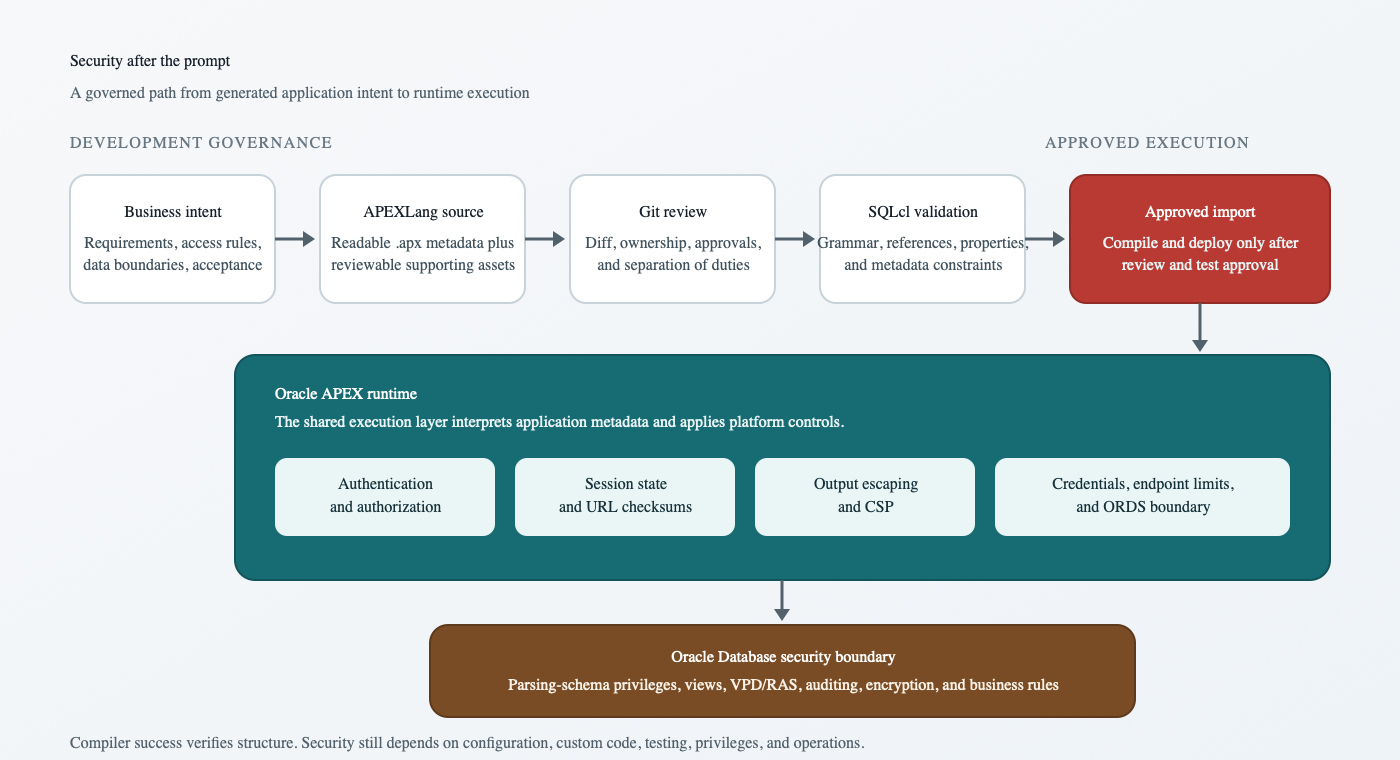
AI helps express application intent, but review and validation happen before an approved import reaches the APEX runtime.
The teal runtime box summarizes the controls discussed earlier in the article. Each one covers a different part of a request:
- Authentication establishes the user’s identity, while authorization schemes decide which applications, pages, components, and actions that identity may access.
- Session state keeps values associated with the correct APEX session; URL checksums help reject unauthorized changes to protected parameters and item values.
- Output escaping controls how application values reach HTML, and Content Security Policy restricts which browser resources may be loaded or executed.
- Web Credentials keep integration secrets out of application code, endpoint restrictions limit where those secrets may be sent, and the recommended ORDS procedure allowlist restricts which database procedures the web gateway may call.
- The Oracle Database boundary underneath the runtime applies the parsing schema’s privileges and any additional controls implemented with views, VPD or RAS policies, auditing, encryption, and database business rules.
These mechanisms remove a large amount of repetitive security plumbing, but their presence in the runtime does not prove that the application configured them correctly. That distinction is the reason review and testing remain visible in the flow.
A practical flow looks like this:
- Start with the business requirement, access rules, data boundaries, and acceptance criteria.
- Let the AI create or modify the APEXLang source.
- Review the
.apxdiff and any SQL, PL/SQL, JavaScript, or static assets in source control. - Compile the APEXLang source with SQLcl and fix every structural error.
- Run the connected validation against the target APEX version and parsing schema as a deployment gate.
- Import only after review, test approval, and the normal separation-of-duties checks.
- Test the running application, including negative authorization cases and browser-facing security behavior.
The smallest offline compiler check is straightforward:
$ sql /nolog
SQL> apex validate -input .
Oracle documents that this command can validate an APEXLang application without a database connection. With a connection, SQLcl may retrieve additional database information for compilation. Import requires a connection and compiles the input before creating or updating the application.
I would not turn Validation successful into a green security badge. It means the source compiled against the relevant APEX metadata model. That is a useful and automatable result. It says nothing about whether the person approving invoices can also approve their own invoice.
Why this can make delivery faster
Security controls are often described as friction added after development. APEX shows why that framing is too simple. A team moves faster when it does not have to implement another session store, credential vault, authorization hook, output-escaping library, component lifecycle, and deployment format for every internal application.
APEXLang adds speed at the change-management layer. A developer or AI agent can work on readable application definitions, Git can show what changed, and SQLcl can reject invalid metadata before an import. Reviewers spend less time navigating a generated codebase to discover how the framework was assembled and more time checking the decisions that are specific to the business.
The runtime also concentrates maintenance. A platform team can patch APEX, configure ORDS, enforce instance settings, and maintain database controls for many applications. That economy does not appear in a two-minute generation demo, but it matters a great deal in year five of an enterprise system.
This is where the productivity argument becomes credible to me. Generating the first page faster is useful, but the larger gain arrives afterward: the team inherits less framework code and receives a source artifact it can review on a runtime with established security mechanisms.
Where the guardrails stop
The HyperFRAME Research analysis makes two qualifications worth keeping beside Oracle’s product story. First, APEXLang trades some freedom and portability for a more consistent Oracle runtime. Second, declarative generation does not remove human accountability.
An AI agent can generate valid APEXLang that defines a sensitive page as public. It can attach the wrong authorization scheme, build vulnerable dynamic SQL inside a PL/SQL process, render a value without the correct escaping, or grant a schema more access than the application needs. The compiler may accept all of those choices because they are syntactically valid.
This is the difference between platform safety and application security. Platform safety gives the team proven mechanisms, constrained components, consistent execution, and a patchable shared layer. Application security depends on how the team configures those mechanisms, reviews generated artifacts, tests failure paths, manages privileges, and monitors production.
The same distinction applies to AI itself. APEXLang narrows what the model is asked to produce, but it does not make the model a security architect. Teams still have to threat-model the requirements, review pull requests, test sensitive flows, and look at production logs when something feels wrong.
Security after the prompt
The first successful AI-generated screen is going to become less impressive very quickly. The lasting question is what happens after that screen exists: who can inspect it, which runtime executes it, where its security controls live, how a bad change is stopped, and how the application receives fixes three years later.
APEX is strong here because it already had an answer before generative AI arrived. Applications are metadata-driven, the runtime owns much of the web and session machinery, and Oracle Database remains the center of data access and business logic. APEXLang makes that application model readable to AI tools and to the people who must govern their output.
The choice of APEXLang instead of JavaScript or Java would not earn my trust by itself. A disciplined delivery process earns it, and APEXLang helps by giving that process a smaller artifact to inspect, a real compiler gate, and an established runtime on the other side. That promise is more modest than automatic security, which is exactly why I can take it seriously in an enterprise project.
References
- Oracle APEX AI Application Generator: Bringing AI to Enterprise App Development
- Introducing APEXLang: The Future of Generative Application Development with Oracle APEX
- APEXLang in Practice: Export, Edit, Validate, and Import Oracle APEX Applications
- Oracle APEX 26.1: Using SQLcl with APEXLang
- Oracle APEX 26.1: Developer Security Best Practices
- Oracle APEX 26.1: Providing Security Through Authorization
- Oracle APEX 26.1: Understanding Session State Management
- Oracle APEX 26.1: Configuring Content Security Policy
- Oracle APEX 26.1: Understanding Web Credentials
- Oracle APEX 26.1: Configuring ORDS
- Oracle APEX 26.1: Understanding the Installation Process
- HyperFRAME Research: Oracle APEX, Declarative AI, and the Managed Runtime
- OWASP: Security Misconfiguration in Low-Code and No-Code Development