Skip to content
APEX from the Field
  • About Me
  • Certifications
  • ACE Profile
  • DevDF
APEX from the Field
Facebook X Instagram
  • PL/SQL Object Types in Practice: Methods, Tables, and a Different Way to Model Data
    PL/SQL

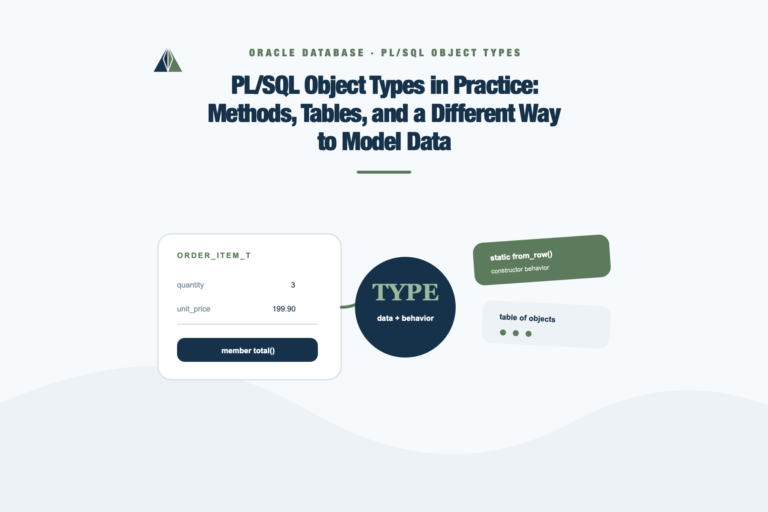
    PL/SQL Object Types in Practice: Methods, Tables, and a Different Way to Model Data

    Bydenioflavio 03/13/202603/13/2026

    By Denio Flavio Garcia da Silva After more than 15 years working with PL/SQL, I still managed to find a feature that genuinely surprised me. I ran into it while preparing for the PL/SQL certification exam (1z0-149), which was easily the hardest Oracle certification I have taken so far. I passed with 66.2%, just above…

    Read More PL/SQL Object Types in Practice: Methods, Tables, and a Different Way to Model DataContinue

  • Instrumenting PL/SQL in Oracle APEX: A Practical Case Using APEX_DEBUG
    APEX | PL/SQL

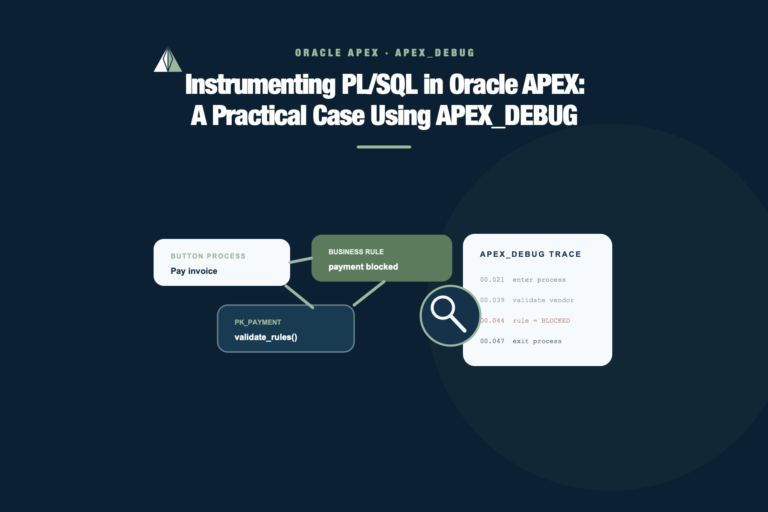
    Instrumenting PL/SQL in Oracle APEX: A Practical Case Using APEX_DEBUG

    Bydenioflavio 03/10/202603/11/2026

    By Dênio Flávio Garcia da Silva There was a moment in my journey with Oracle APEX when I started working on larger enterprise applications and realized that the page itself was often the simplest part of the whole system. The UI looked clean and straightforward, but behind a single button there were packages with hundreds…

    Read More Instrumenting PL/SQL in Oracle APEX: A Practical Case Using APEX_DEBUGContinue

  • Oracle APEX Background Processing with Execution Chains (Live Progress Monitor Demo)
    APEX

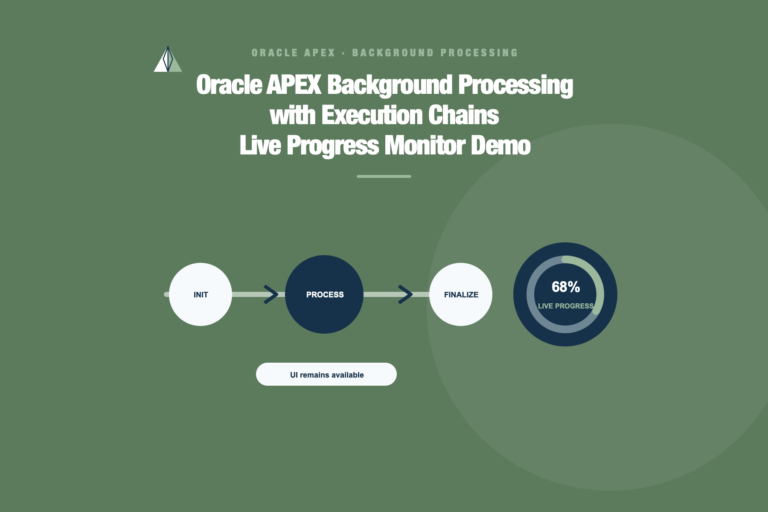
    Oracle APEX Background Processing with Execution Chains (Live Progress Monitor Demo)

    Bydenioflavio 03/07/202603/07/2026

    In this video, I built and recorded a practical Oracle APEX demo showing how to handle long-running tasks without freezing the UI. The app starts a background Execution Chain (Init → Process → Finalize), returns control to the user immediately, and displays live progress on a Monitor page (status, “X of Y”, messages, and item-level…

    Read More Oracle APEX Background Processing with Execution Chains (Live Progress Monitor Demo)Continue

  • When Two Users Edited the Same Record
    PL/SQL

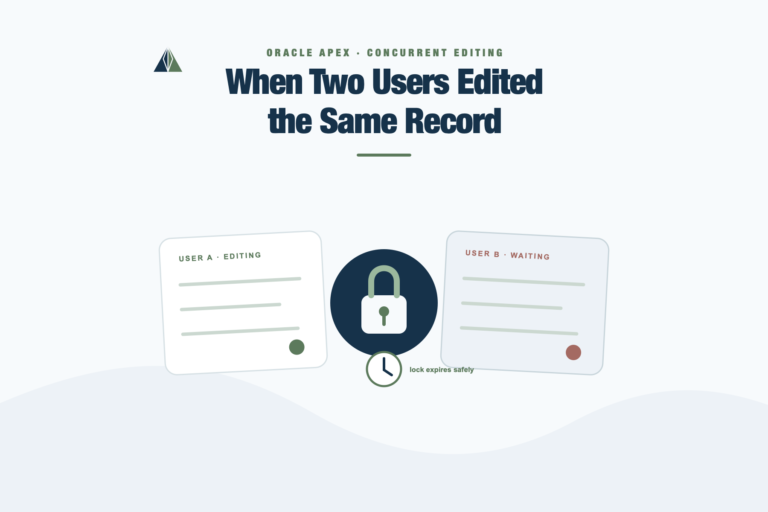
    When Two Users Edited the Same Record

    Bydenioflavio 03/03/202603/03/2026

    By Dênio Flávio Garcia da Silva There are certain problems in enterprise applications that only show up after a system has been in production for a while. They don’t appear during development, they don’t fail loudly, and they don’t generate stack traces. They just quietly corrupt user expectations. One of those problems is concurrent editing….

    Read More When Two Users Edited the Same RecordContinue

  • Securing ORDS Endpoints with OAuth2
    APEX | ORDS

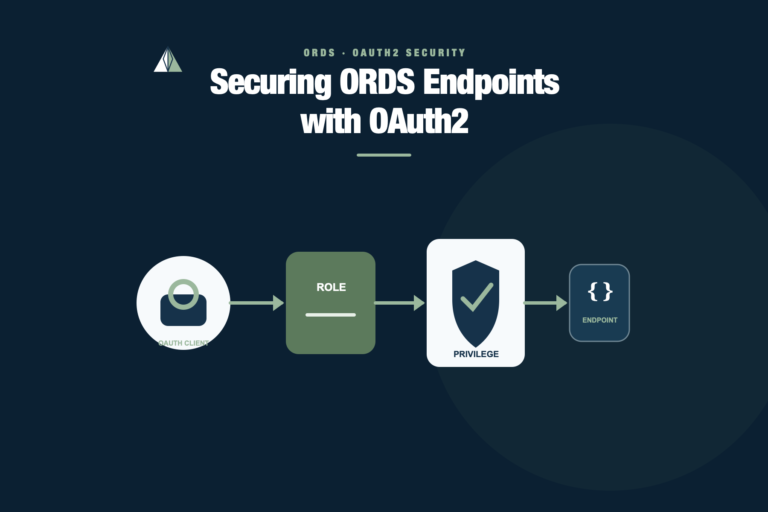
    Securing ORDS Endpoints with OAuth2

    Bydenioflavio 02/16/202602/16/2026

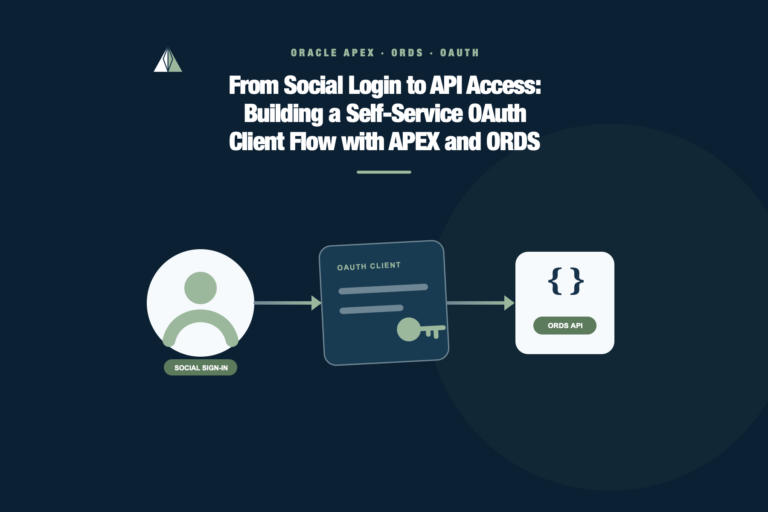
    In this article, I demonstrate how to secure ORDS REST endpoints using OAuth2 Client Credentials within Oracle APEX running on Autonomous Database (OCI). The post walks through creating roles and privileges via the APEX RESTful Services interface, configuring an OAuth client using SQL Workshop, and validating the full authentication flow using Postman. This example highlights machine-to-machine security architecture and best practices for protecting exposed ORDS APIs.

    Read More Securing ORDS Endpoints with OAuth2Continue

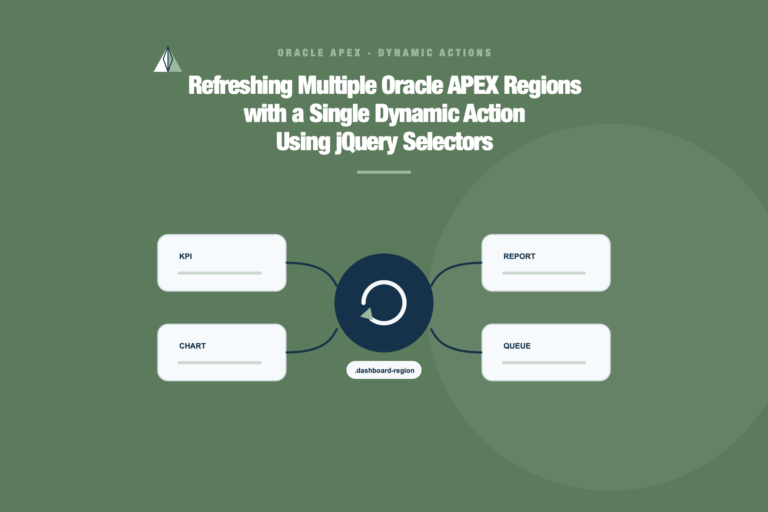
  • Refreshing Multiple Oracle APEX Regions with a Single Dynamic Action Using jQuery Selectors
    APEX

    Refreshing Multiple Oracle APEX Regions with a Single Dynamic Action Using jQuery Selectors

    Bydenioflavio 02/10/202603/04/2026

    In this video, I demonstrate a practical Oracle APEX dashboard pattern that uses a single Dynamic Action combined with a jQuery selector to refresh multiple regions at once. The demonstration starts with a simple page containing filters and one report region refreshed by a button. As the page evolves into a real dashboard with multiple…

    Read More Refreshing Multiple Oracle APEX Regions with a Single Dynamic Action Using jQuery SelectorsContinue

  • Updating XML Stored as CLOB in Oracle Using XMLQuery
    SQL

    Updating XML Stored as CLOB in Oracle Using XMLQuery

    Bydenioflavio 01/31/202602/03/2026

    Using a simplified shopping cart XML example, the content shows how to safely modify an XML element while properly handling namespaces and following the required copy / modify / return pattern defined by the XQuery standard.

    The example intentionally reflects real-world constraints, where the XML is already stored as CLOB and changing the data model to XMLTYPE is not an option. The focus is on clarity, maintainability, and correct usage of supported Oracle XML features rather than deprecated functions.

    Read More Updating XML Stored as CLOB in Oracle Using XMLQueryContinue

Page navigation

Previous PagePrevious 1 2

Search

Categories

  • APEX (11)
  • ORDS (4)
  • PL/SQL (8)
  • SQL (3)

RECENT posts

  • From customer complaint to service recommendation: automatic vector search with ORDS AutoREST08/02/2026
  • When a Purchase Request Needs More Than a Chat Window07/12/2026
  • When APEX Needs a Custom Home Page07/05/2026
  • I Needed Feedback for an APEX AI Agent. The Feature Was Already There06/21/2026
  • What the APEX URL Is Actually Doing05/13/2026

Tags

Agents Ajax Callback annotations API authentication scheme Collections debug Dynamic Action dynamic content feedback IA jQuery n2sql oauth ords pl/sql plsql Process Social Sign-In sql type url Vector Search xml

  • About Me
  • Certifications
  • ACE Profile
  • DevDF
Linkedin Github YouTube

© 2026 APEX from the Field

  • About Me
  • Certifications
  • ACE Profile
  • DevDF